
Tuckpointing & Repointing
Mortar joints are the glue holding your chimney together — and the first thing North Texas weather eats. We grind out the failed mortar and repack every joint with color-matched mortar that disappears into the wall.
What is tuckpointing?
Tuckpointing — repointing, if you want the mason's term — is the repair of the mortar joints between your chimney's bricks. Those joints do more than fill gaps: they bond the bricks into a single structure, distribute the stack's weight evenly, and seal thousands of linear inches of seam against rain. Brick can last a century; the mortar between it is designed to be the sacrificial part, weathering away so the brick doesn't. Around DFW, sun, sideways spring storms and winter freeze–thaw cycles usually start crumbling joints in 20–30 years — sooner near the top of the stack, where the weather hits hardest.
Grinding to proper depth — the part that matters
Real repointing starts with removal, not application. We grind or rake each failed joint out to roughly twice the joint's width — deep enough that fresh mortar has solid material to lock into on three sides. Then the joints are cleaned, dampened and packed in tight lifts, and tooled to match the original joint profile. Skip the grinding and you get the classic handyman "buttering" job: a thin cosmetic skim that pops off in a season or two and leaves the joint worse than before.
Color-matched, strength-matched mortar
A repointed chimney should look like nothing ever happened. We blend mortar to match your existing joints in color, sand texture and profile, so repairs vanish instead of striping your chimney with gray patches. Just as important is matching the mortar's strength: modern bagged mortar is often harder than older brick, and mortar that's stronger than the brick forces every bit of thermal and soil movement into the brick faces — which is how "repaired" chimneys end up spalling. Right mix, right depth, right profile. That's the whole craft.
Why DIY caulk makes it worse
Caulk and surface smears are the most expensive cheap fix in masonry. They seal the crack's face while trapping moisture inside the joint, where expansive clay soil movement and freeze–thaw keep grinding away invisibly. Water is the villain in every masonry story — the fix is never to trap it, but to rebuild the joint so it sheds. Failed joints are also structural: mortar loss is how chimneys start leaning, which is why we photograph every stack before and after and follow CSIA and NFPA-informed standards on all masonry work.
Signs your mortar joints are failing.
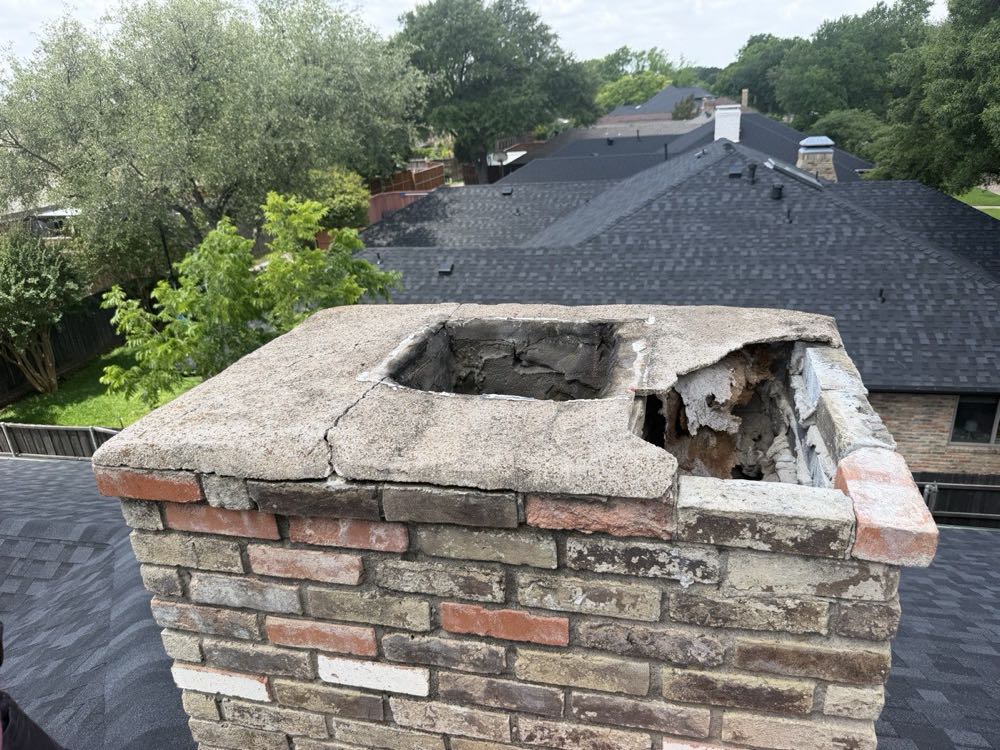
Crumbling or sandy joints
Rub a joint and get sand on your finger? The binder has weathered out and the joint is done.
Recessed or missing mortar
Joints worn back into shadowed grooves — or gaps you can slide a key into — are open water channels.
Cracks tracking the joints
Stair-step cracks running along the mortar lines signal movement, often from DFW's expansive clay soil.
Mortar debris at the base
Gray crumbs collecting on the roof or flower bed below are pieces of your chimney letting go.
White staining after rain
Efflorescence blooming across the brick means water is moving through joints that should be sealing it out.
Old patch jobs failing
Flaking smears or caulked joints from a previous "repair" are trapping moisture and hiding the real damage.
Ground out, packed tight, matched perfectly.
Joint-by-Joint Inspection
We assess every face of the stack, probe the joints, and show you photos of exactly which sections have failed.
Mortar Matching
Color, sand texture, joint profile and strength are matched to your original mortar so repairs disappear.
Upfront Price
You approve one clear, all-in number — scoped by area and access — before a grinder ever touches the wall.
Grind, Pack & Tool
Joints ground to proper depth, packed in tight lifts, tooled to match — with before-and-after photos of the finished work.
Tuckpointing, answered.
How much does chimney tuckpointing cost in DFW?
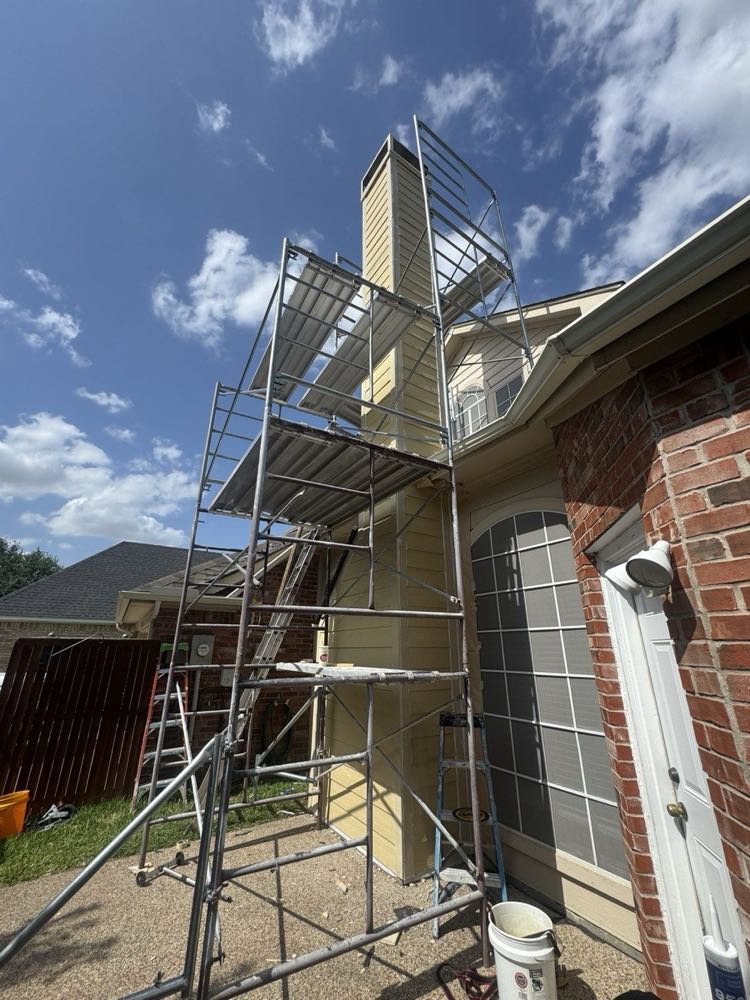
Most chimney tuckpointing jobs in Dallas–Fort Worth run $500–$2,500 depending on how much of the stack needs repointing and how hard it is to reach — a few joints near the roofline costs far less than a full two-story chimney on scaffolding. You get an exact, all-in price after a $49 inspection.
What's the difference between tuckpointing and repointing?
Homeowners use the words interchangeably, and for chimney repair they mean the same job: removing failed mortar and packing fresh mortar into the joints. Technically, tuckpointing is the decorative version with contrasting fine lines; repointing is the structural repair. Either way, the work that matters is the same — grind deep, pack tight, match the original.
Why can't I just smear new mortar or caulk over the joints?
Surface smears have nothing to grip — they flake off within a couple of seasons, and caulk traps moisture inside the joint where freeze–thaw keeps destroying it out of sight. Proper repointing grinds the joint out to roughly twice its width so the new mortar locks in mechanically and cures as part of the wall.
Will the new mortar match my chimney?
Yes — we blend mortar to match your existing joints in color, texture and joint profile, and we match the mortar's strength to your brick. That last part matters: mortar that's harder than the brick forces movement stress into the brick faces and causes spalling.
How long does tuckpointing last?
Done to proper depth with correctly matched mortar, repointed joints should last 25–30 years or more. Pairing the work with a breathable waterproofing treatment helps the whole stack shrug off DFW's storm seasons even longer.
Often paired with tuckpointing.
Strong joints, invisible repairs.
Book a $49 inspection and get an exact, upfront price — with photos of every joint before and after.
(469) 980-1178One call keeps the fire where it belongs.